Mar 112012
 

My blog uses the Suffusion Theme (a very good one), of which it is time to update.  You, the reader, shouldn’t notice too much–or at least that is my hope.  If all goes well it will take only minutes… otherwise, my blog may look rather strange for awhile!

Wish me luck :)

 Posted by at 11:00 pm
Mar 082012
 

I was able to go to GDC 2012 yesterday—up in San Francisco—where I got to meet and talk with many great people and had a lot of fun.  Coupled with a few after-show swank parties, I finally drove home beat.  I’ll be going again tomorrow and hope to be able to check out the Expo floor in greater detail.

I don’t get to go to the GDC every year, but it seems like with each show the industry’s population is exploding!  Crazy!!!  I did get a chance to talk one-on-one with some Social/Mobile developers and defiantly helped me figure out what I need to be doing more to ‘break’ in to that Space.


 Posted by at 5:33 pm
Jan 082012
 

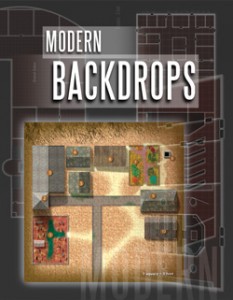
Modern Backdrops
System: Modern d20
Publisher: RPGObjects (www.RPGObjects.com)

The book was written as a resource intended to allow a game master to incorporate ready-made urban settings into their campaigns. Each urban setting is its own chapter, ordered chronologically according to the population size – smallest to largest. Information about each setting is ordered into standardized sections with additional information for the GM (GM Notes) in letter boxes where needed, game stats tend to be towards the end of the chapter, while maps will be sprinkled about.

The first urban setting is well done, but overall there are a few problems with the book that make the later urban settings less appealing to use. The problems namely deal with the organization and scope of the chapters.

Organization:
Each chapter contains sixteen sections—Intro, GM Notes, What Every School Kid Knows, Rumors, Important People, Other Information, Community Events, Timeline, More Important People, Places to Go, Organizations, Official Reports, Places of Power, Things to See, Supernatural Residents, Dark Secrets, and Plot Hooks—which is overkill. Several sections contain similar types of information (Important People & More Important People for instance) and can make it difficult to find info on something as there is often more than one place to look! The information in each chapter could easily have been reworked into fewer more precise sections

Scope:
As each consecutive (in the book) urban area’s population increases, more and more information about the area gets glossed over, especially so as each area is detailed in only ~18 pages. It’s nice the author tried to tackle larger towns, but the space in the book wasn’t appropriate considering.

Overall the book was good, though it really should have been twice the size to handle the larger towns. But, the plot ideas presented were interesting and worthwhile.

I have two other gripes, but only in that these are due to my personal play & game-master styles:
1 – The maps in the book are too simplistic for my taste. Also, there could have been additional maps for the outlying areas around the town (rather than just the town square…)
2 – All of the adventures deal heavily with the supernatural but present no other type of challenge or adversary. Of the supernatural used in the book, a large portion were spirits or ghosts—a zombie or ghoul (or even a were creature) would have made for a better variety of adventure hooks.

 Posted by at 10:40 pm
Jan 052012
 

I’ve been writing, off and on since Nov 2011, a new RPG.

I’m finding the process to be rewarding – I get to comb through my large library of games and pick out rule systems I think works. Piecing them together in what I hope will be a decent RPG has proven challenging as I have to think about the ramifications of my choices before even writing.

At the core, the game rules are a mashup of GURPS, Interlock System, and elements of Fudge. While the game “world” is SciFi Space, though it is coming along more slowly than the rules.

 Posted by at 2:02 pm
Nov 162011
 

After a somewhat long hiatus—due mostly to my sister’s wedding, getting sick and feeling like death warmed over for a couple of more weeks, and traveling a lot—life is finally returning to normal.

I’ve been able to play a few more games—social (Facebook) and Xbox 360 mostly—and hope to find the time to do some write-ups.

I’m also working on several game ideas too; a social game that I think will overcomes the Facebook Game Flaw, and a table-top RPG system and genre. I plan on not sharing either here, not in to great a detail, and not for awhile anyway, as I want to develop them further.

However, crafting a whole new RPG from scratch is a new endeavor for me as I’ve played/Game-Mastered a slew of different RPG’s for the last 30yrs or so, but never actually written one. I have a decent selection of good, high-quality RPG game books – both systems and settings – to draw inspiration from, which helps a lot. I am finding though, that writing the rules is far easier than writing setting information…

 Posted by at 10:09 pm
Aug 302011
 

I’ve made mention of this before but wanted to clarify and expand upon the issue.

I believe most Facebook games have a distinct design flaw.  Facebook is about being social and incorporating a social network into a game is a great idea!  But too many games rely upon the mechanic that only a friend can unblock progress/development in the game.  This creates a direct correlation between how many friends play a game and how successful the player will be… that is, more friends = more fun.

Correction: The more friends that actively play the same game as the player results in the more successful the player will be at the game, as they will spend less time blocked from advancement!

Requiring a player to develop and maintain a network of other active players can quickly become an annoyance – especially in games that singularly rely on this mechanic – and eventually, I think, is the game’s ultimate demise.

A player should always be able to play the game(s) they like to play without being arbitrarily blocked/hindered from advancement because of a simple Yes/No choice of another player to help or not.  Advancement in a game really should be about what the player does, the choices they make, and more over their successes and failures the have while playing a game.  That is not to say friends couldn’t (or shouldn’t) influence a game though.

I’d still like to see, let alone find, more games on Facebook that incorporate friends into the play experience, but that doesn’t block/hinder my own advancement in the game based on their actions.


Aug 302011
 

This theme is great, very customizable – but I killed the little author link.  Found it tucked away and now it’s gone! hehehe

 Posted by at 11:20 am
Aug 302011
 

It’s been a slow week on the blog – not sure if I want this to go public yet or even if I want a blog.  I do know I need to post more often and get into the habit of posting.  So here it is… don’t you feel blessed?

I also need to figure out how to remove the Suffusion theme by Sayontan Sinha link at the bottom… annoying to say the least.

 Posted by at 10:41 am
Aug 212011
 

Lucky Train is about managing train schedules. The game is well developed (not buggy) and look reasonably good, I do beleive there is a distinct design flaw however in that there is a direct correlation between how many of your friends actively play the game and how successful you will be. You create trains and choose which player to send it too – more friends that play the game equals more trains that can be created/scheduled, which equals more money & experience. While a lot of Facebook games also rely on a similar correlation, the flaw is that scheduling trains is the only mechanic to generate $/xp. There are a few NPC characters you can create trains and schedule with, but the turn around time while “shorter” than trains sent to friends is still long enough that you can find yourself waiting awhile to be able to perform another action.

Generating $/xp is also slow. While a few basic items are cheap, the prices quickly become more expensive. It seems like the game was designed for people with dozens of friends who also actively play the game… or for those willing to use real-world money to purchase items.

Lastly, an empire/city building mechanic is a big part of the game – you purchase/place new buildings and can later upgrade them. You can also at any time upgrade train engines to better models – also expensive – which will improve travel times and the length of the train (increase amount of passengers = $/xp)… slightly. :(

You cannot, however, move/edit/create new train tracks or move the station – which I think would be two key elements to any train empire building game!

Rate: 3/5

Improvements:
– edit tracks/station
– add additional methods to generate $/xp
– add additional items that are moderately priced
– designers should address fun factor for small groups of friends (2-5)